The new University of Iowa AI Industry Advisory Board connects university leaders with industry experts to help understand how artificial intelligence is reshaping the workplace and prepare students, faculty, and staff to thrive in an AI-enabled workforce.
The board brings together leaders with experience in technology services and operations, AI and product development, risk management, law, and talent management. Their perspectives will give UI insight into how organizations are navigating AI adoption and changing workforce demands while creating opportunities for the university to share what it is learning through its own exploration of responsible AI use in education, research, administration, and health care.
The board first met virtually in spring 2026 and convened on campus Sept. 18 for its first in-person meeting, where members and university leaders discussed workforce transformation, AI-enabled teaching and research, and other opportunities and challenges emerging as the technology evolves.
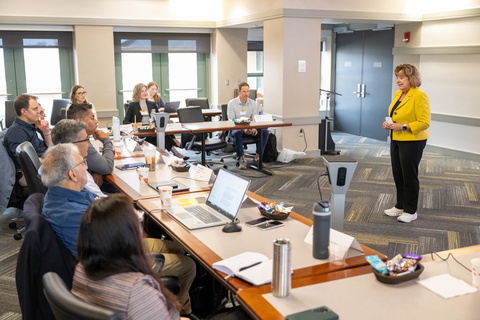
“Bringing together leaders from across industries gives us an important perspective on how AI is changing organizations and the workforce,” says Brad Rohrer, associate vice president and chief information officer. “This board creates an opportunity for genuine exchange that can help us make thoughtful decisions at Iowa while also sharing what we learn with our industry partners.”
During the September meeting, participants explored workforce transformation from two perspectives: Preparing students for evolving expectations in their future careers and helping faculty and staff build the knowledge and skills they need to be successful in an AI-enabled environment.
Board member and Iowa alumna Lisa Carmack, a global people strategy partner for Vylor, a seed and genetics company based in Johnston, Iowa, says she joined the board to help shape the university’s approach to AI and prepare students for a changing workplace.
“Throughout their careers and lives, students will encounter new disruptive technologies, like AI, that require them to reach outside their comfort zone,” Carmack says. “Providing safe, yet challenging environments for students to learn, make mistakes, and develop skills and experience using AI helps them prepare for their careers.”
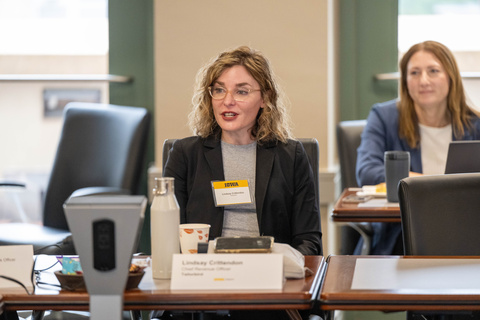
The conversation reflects Iowa’s broader approach to AI: empowering people to use the technology and explore its potential while considering appropriate use, transparency, risk, and institutional responsibility. Participants discussed the importance of creating opportunities for exploration across disciplines, recognizing that the ways AI can enhance teaching, research, and day-to-day work will vary across fields.
Iowa alumna and board member Lindsay Crittendon, is chief revenue officer for Tailorbird, a technology company that uses AI to help apartment owners plan and manage building renovations and repairs. Crittendon is drawing on her Silicon Valley experience to help the university successfully integrate AI.
“This is a massive sea change, and I’d like Iowa to be one of the places to lead it,” she says.
Crittendon noted that while private sector change often comes from the top down, that approach doesn’t always translate at a decentralized university. She pointed to a Silicon Valley model in which engineers are embedded within different disciplines to identify opportunities from the ground up.
“For example, the people in the political science department know what they can do better than someone in a central office,” Crittendon says. “Having an AI expert and business-process thinker paired with a subject-matter expert means you could have a million flowers blooming. Everyone can learn from one another.”